Programme of the candidate for appointment as Rector of TBU · 2026–2030
A self-confident, useful and internationally respected TBU
UTB as a self-confident, useful and internationally respected university that creates high-quality conditions for students and staff alike and turns knowledge into tangible societal and economic benefit.
Starting point and strategic anchoring
Tomas Bata University in Zlín stands before a period that will be decisive for its future standing in the Czech and European higher education landscape. Demographic developments, the transformation of the labour market, the rise of artificial intelligence, pressure on research quality, international competition and the expectations of the young generation all demand clear priorities, stable leadership and the ability to translate strategic documents into everyday practice. At the same time, UTB enjoys a unique advantage: the Baťa tradition of useful education, entrepreneurship, creativity, responsibility and service to the region.
The programme presented here builds on the six pillars of the UTB Strategy 26+ – education; research and creative activities; internationalisation; the third role; human resources and the internal environment; and funding and strategic management. It also draws on the good practice of the long-established traditional universities in the Czech Republic: particularly in developing research excellence, doctoral study, open science, talent development, active international partnerships and modern university administration. This is not about copying other institutions, but about applying proven principles in a way that respects the size, structure and identity of UTB.
Strategic goals will be translated each year into concrete implementation plans with clearly defined responsibility, a timetable and continuous evaluation of the results achieved. I am convinced that the university's success will depend above all on our ability to focus our energy on the priorities that truly matter and to pursue them consistently. The rector's role is not merely to set the direction, but to create the conditions for joint work, to connect the individual parts of the university and to bear responsibility for ensuring that the decisions taken lead to concrete results. The further development of UTB will be a shared task for the university's leadership, the faculties, academic staff, employees and students. It is precisely cooperation, clear responsibility and consistency in delivering the agreed goals that will be decisive in enabling UTB to continue developing as a self-confident, high-quality and respected university.
Principles of university leadership
Respect for the faculties
The Rectorate should provide high-quality shared services, standards, data and support. It should not substitute for the strategic responsibility of the faculties, nor centralise decision-making unnecessarily.
Trust and responsibility
Students and staff alike need a predictable environment, open communication and clearly defined competences. Trust must go hand in hand with responsibility for results and quality.
Measurability without formalism
Every priority will have an owner, a timetable and a limited number of meaningful indicators. The aim is not more reporting, but better decision-making and visible progress.
Partnership instead of isolation
UTB will systematically connect faculties, students, academics, alumni, businesses, public administration, schools, hospitals, cultural institutions and international partners. This is the very motto I championed when founding the Association of Deans of Economics Faculties.
A strong voice for UTB in Czech higher education
I want to build on my experience of leading a faculty and the association of deans, and systematically strengthen UTB's representation in the key representative bodies, working groups and expert forums of Czech higher education. To take an active part in debates and in the preparation of decisions by the MŠMT (Ministry of Education), TA ČR and other important institutions, so that UTB is not merely a recipient of change but a respected partner in shaping it.

1
Digitalisation connected with study
The student must be a partner of the university, not merely a recipient of teaching. The goal is an environment in which students understand the purpose of their studies, have support readily available, gain practical and international experience, and can develop their talent in academic, professional, entrepreneurial, sporting and cultural fields. Students should also have their representation in the newly conceived university boards of public higher education institutions.
- High-quality and flexible study. Regularly innovate degree programmes in line with the development of disciplines and the needs of society and the labour market, with a clear orientation towards project-based, team-based, simulation-based and problem-oriented teaching, interdisciplinary modules, micro-credentials and opportunities for more individualised study paths.
- From applicant to successful graduate. Systematically evaluate why applicants choose UTB, or why they prefer other higher education institutions, and reflect these findings in the quality, attractiveness and continuous innovation of degree programmes and in the way they are communicated, underpinned by long-term cooperation with secondary schools and work with talented pupils; strengthen recruitment into degree programmes taught in Czech while at the same time improving progression through study and the conditions for its successful completion. Further support these steps, also thanks to the JOB CENTRE, through timely support, high-quality counselling, an appropriately calibrated study load and the removal of unnecessary obstacles during the course of study. This development must be followed by a systematic increase in the recruitment of international students into Bachelor's and Master's degree programmes taught in English, as an important part of internationalisation and the further development of UTB. In both Bachelor's and follow-up Master's programmes, carefully consider a focus on promising countries. In these programmes, we have long been the most successful in the Czech Republic in admissions from Vietnam and India.
- Successful progression through study. Systematically monitor the causes of study failure and introduce timely support for students at risk, tutoring, mentoring, high-quality induction activities and accessible counselling services.
- Institutional accreditation and a culture of quality. Systematically prepare the extension of institutional accreditation to UTB's key fields of education. Work with feedback from students, graduates and employers, analyse the actual study load and the calibration of ECTS, and continue to involve students intensively in evaluating the quality of teaching.
- Teaching competences and accessible study. Develop university-level support for modern teaching methods and pedagogical competences, including digital education supported by the Fénix Centre for Digitalisation and Multimedia Technologies (U6). Ensure high-quality conditions for students with specific needs, for talented students, and for part-time and flexible forms of study.
- Student into a project / Student into a company. Connect students with the real challenges of research teams, businesses, cities, hospitals and non-profit organisations. Every student, not only those in professionally oriented programmes, should have the opportunity to gain valuable project, research, entrepreneurial or international experience during their studies.
- Campus and student life. Create a visible centre of student life, provide stable support for student societies, events such as BarCamp, No Limits Meet Up and other community activities, strengthen sport, culture and wellbeing, push through the construction of the UTB sports hall and complete the UTB Student Club.
Commitment for 2026–2030
Strengthen study success and the partnership role of students, extend institutional accreditation and ensure accessible support. Create a real opportunity for every student to gain high-quality practical, project, research, entrepreneurial or international experience during their studies. Publish concrete measures to improve the quality of study and strengthen accessible student support.
2
A university for academic staff and employees
A strong university cannot be built without motivated, respected and professionally growing staff. Academic staff need time and conditions for high-quality teaching, research and cooperation with practice. Technical and administrative staff need clear processes, high-quality leadership and recognition of their expertise. My programme therefore places the working environment and the development of people on the same level as student priorities.
Career development, evaluation and remuneration
- A stronger and healthier team spirit and cooperation across UTB. I want to systematically foster the emergence of a stronger university team and overcome the barriers between individual faculties and other units. UTB can succeed in the long term only if we manage to connect our professional capacities better, share experience and coordinate our efforts for the benefit of the whole university. It is precisely stronger cooperation across UTB that I am convinced is one of the preconditions for improving the university's results and the key indicators described in the following parts of this programme. Part of this change will also be support for shared university activities that connect employees of the individual units in a natural way – for example through voluntary team games with a sporting, knowledge-based or entertaining dimension. This should not be merely another “sports day”, but a format built on healthy rivalry, cooperation and shared experience, helping to strengthen mutual trust and the awareness that the success of individual units is at the same time the success of the whole of UTB.
- A predictable career path. Refine the university framework for career development so that staff know what is expected at each stage of the academic and professional career. Respect the differences between disciplines, while at the same time ensuring transparency and comparable principles.
- Strategic personnel planning and the HR Award. Introduce medium-term planning of personnel needs, succession and talent development at the faculties and other units. Extend the HR Award to further units as a practical standard for high-quality recruitment, evaluation, equal pay, support for diversity and workplace wellbeing.
- Balanced evaluation. Evaluate not only publication and project results, but also the quality of teaching, student supervision, team building, knowledge transfer, the third role and service to the academic community. High-quality teaching must not be perceived as less valuable than research.
- Remuneration according to contribution. Continue to increase the transparency of personal evaluation and extraordinary bonuses. Create conditions for recognising excellent teaching, successful project teams, high-quality supervision of doctoral students and exceptional contributions to the university. Define special motivational bonuses at UTB level, above all for those results successfully reported on behalf of UTB in Module M1 or M2.
- Support for leaders. Develop the leadership of deans, vice-deans, institute directors, heads of departments and administrative units. High-quality people management is a professional competence that requires training, the sharing of experience and feedback.
A process-based approach: less administration, more time for professional work
- A transition to process management following an audit of administrative burden. Identify duplication and triplication in reporting, record-keeping and controls. Every new requirement must have a clear purpose and, wherever possible, replace an existing activity rather than add a new obligation. On this basis, process management can be introduced across agendas. This principle has already been proven at a number of higher education institutions and in an MŠMT (Ministry of Education) project.
- High-quality central services. Professionalise project, legal, personnel, financial, IT, library and communication support. Faculties and teams must receive practical help, not new methodological complications.
- Digitalisation of agendas. Interconnect information systems, automate repetitive activities and use AI in preparing documents, analysing data and standardising procedures. Measure the time saved and return it to teaching, research and work with students.
A safe, fair and supportive working environment
- Social safety. Strengthen trustworthy mechanisms for preventing and addressing inappropriate behaviour, ombudsperson and counselling services, and whistleblower protection. The rules must be comprehensible, accessible and applicable to everyone.
- Wellbeing and balancing roles. Support mental health, flexible forms of work where the nature of the activity allows, return from parental leave, and a sensible balance between academic, research, managerial and personal demands.
- Equal opportunities and work with talent. Actively seek out talented staff, support their professional growth and create conditions for retaining young academics, researchers and top experts from practice and from abroad.
Commitment for 2026–2030
Build a stronger UTB team, transparent career development and remuneration, and support leadership, social safety and wellbeing. Demonstrably reduce administrative burden and evaluate the working environment and professional growth every year.
3
Research excellence, doctoral study and open science
UTB must purposefully develop the areas in which it can be scientifically respected and at the same time useful to society. Support for research should not mean spreading limited resources thinly, but a combination of open competition, the development of promising teams and the protection of high-quality disciplines with long-term potential. Naturally, our management will need to respond to the outcome of the institutional evaluation carried out by the MŠMT (Ministry of Education). I am firmly of the view that we should take the result as a challenge, so that together we achieve a move from the current category C to category B. What can we do together to achieve this?
- Systematic management of research quality. Prepare and evaluate annually a university plan for raising research quality aimed at moving UTB from category C to category B in the next institutional evaluation. For the individual major disciplinary areas, monitor the development of the quality of results in Modules 1 and 2, the share of Q1 and D1 outputs, citation impact, disciplinary relevance, international cooperation, societal benefit and the quality of the research environment.
- Carefully redefine the directions of excellence, and even more carefully carry out research benchmarking instead of looking in the rear-view mirror. Benchmark these results against comparable Czech and European institutions and, on that basis, direct support purposefully towards promising teams as well as areas whose performance needs to improve. Establish incentives for this performance at UTB level, not only at faculty level. The aim will not be to maximise the number of outputs, but to raise their quality and thereby create a more balanced research profile for the whole of UTB.
- Evaluation by quality, not by quantity. Combine bibliometric and discipline-specific indicators with expert peer review, societal impact and the recommendations of international evaluation panels. Direct support towards teams that demonstrate quality, promise and the capacity for international cooperation.
- Excellence with impact. Support interdisciplinary themes that bring together the strengths of the faculties: AI and digitalisation, materials and recycling, sustainability, health, safety and security, the creative industries, economics, management and industrial applications.
- Professional project support. Introduce internal review of major proposals, mentoring by experienced investigators, support for building consortia, and administrative services from the preparation of an application through to implementation and the communication of results.
- Doctoral students as junior colleagues. Raise the quality of supervision, regular progress evaluation, methodological support, international experience and the involvement of doctoral students in teams. Create a university doctoral platform for shared courses, methodology, academic writing, ethics and career preparation. Develop this platform as the Baťa Doctoral School, with shared methodological, ethical, language and transferable competences and with systematic monitoring of the quality and completion of doctoral study.
- Postdoctoral researchers and returning talent. Create targeted positions for young researchers, support returns from abroad and bring in experts who can establish or strengthen promising research groups. I have in mind not only Czech postdocs, but also the intensive recruitment of postdocs from abroad – a programme that has in the past also been supported by the Zlín Region.
- Open Science and integrity. Develop FAIR data, open publishing, high-quality research data management, ethics and reproducibility. Evaluate results responsibly according to disciplinary standards, not merely by mechanically counting outputs. Strengthen the role of data stewards and practical support for research teams in preparing data management plans and putting FAIR principles into practice.
Commitment for 2026–2030
Steer UTB from category C to category B in the institutional evaluation, raise the quality of outputs and projects, and develop promising teams. Strengthen the Baťa Doctoral School, postdoctoral positions, international cooperation, Open Science and FAIR data.
4
AI, digitalisation and a secure university
Artificial intelligence is not a standalone discipline confined to a single faculty. It is a cross-cutting competence, a research tool, a theme for cooperation with practice and a means of simplifying how the university operates. UTB has the opportunity to create a model of responsible and practical AI adoption that respects academic integrity, data security and the differences between individual disciplines.
- AI literacy for every graduate. Embed the possibilities, limits, ethics and practical use of AI in the graduate profiles and learning outcomes of all degree programmes. The scope and form must correspond to the discipline – differently in technical, economic, health, humanities and creative fields.
- AI competences of academic staff. Ensure regular training for teachers and researchers, access to the necessary tools, support in designing courses and the sharing of good practice. Clearly define the rules for the use of AI in assessment, final theses and research.
- UTB AI Centre. Establish an interdisciplinary platform that will not compete with the faculties, but will provide methodological, technological and project support to faculties and students alike. The Centre should coordinate internal AI services, education, research projects, transfer and the offer for companies, schools and public administration.
- A digital university. Create a long-term architecture for information systems, remove incompatible records and develop a unified data environment. Leadership decisions must be based on available, comprehensible and verifiable data. The priorities will be the secure interconnection of key agendas, the digitisation of records management and study agendas, the modernisation of the financial information system and rigorous management of data, access rights and the life cycle of systems.
- Cyber and data security. Strengthen the protection of systems, personal and research data, know-how and intellectual property. Security should not be perceived merely as a technical agenda, but as the responsibility of every user.
- Physical and operational security. Create a unified framework for the protection of buildings and workplaces, crisis preparedness and operational continuity. Regularly test security scenarios and educate students and staff so that security becomes part of the university's everyday culture.

Commitment for 2026–2030
Anchor AI competences in all degree programmes, stabilise the UTB AI Centre and develop a secure digital and data environment. Demonstrably simplify administration and strengthen cyber, data, physical and operational security.
5
An entrepreneurial UTB, knowledge transfer and partnership with practice
The Baťa tradition commits UTB to entrepreneurship, practical impact and the courage to test new ideas. Entrepreneurship does not mean only founding companies. It encompasses the ability to take responsibility, work with uncertainty, connect disciplines and translate knowledge into innovation, public services, cultural projects and solutions to societal problems.
- A single path from idea to application. Establish a clear university process for the protection and use of know-how and intellectual property, licensing, the founding of start-ups and spin-offs, and cooperation with investors. The rules must protect UTB and at the same time motivate the authors of solutions.
- Professional transfer support. Strengthen the personnel, legal and financial capacities of transfer, education in intellectual property protection and the active identification of results with commercial or societal potential. Transfer services must be available to all faculties and teams.
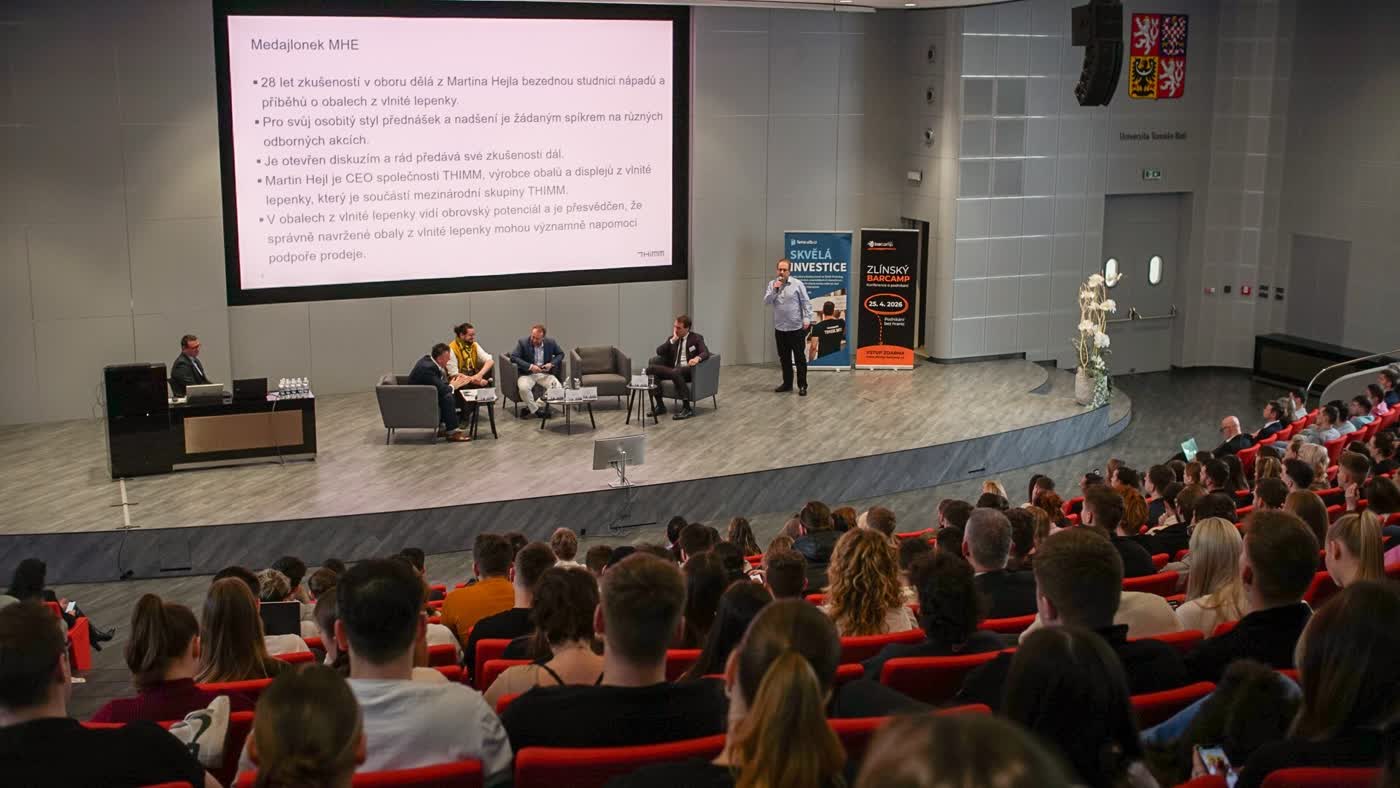
- Pick and play entrepreneurship. Connect multiple activities: UPPER, Garage Angels, No Limits Meet Up, BarCamp, the Czech Management Association, alumni and corporate partners into an accessible system of mentors, prototyping, customer-need validation, business model testing and initial funding.
- Students and academics in one team. Develop interdisciplinary teams in which technological, materials, health or creative projects are combined with management, economics, marketing, design and legal support. The student should not be merely an auxiliary workforce, but a co-author of the solution.
- Long-term strategic partnerships. Instead of isolated commissions, build multi-year relationships with businesses, hospitals, cities, the region, schools and cultural institutions. Jointly set thesis topics, internships, contract research, case studies and employee training.
- Lifelong learning and micro-credentials. Expand the flexible offer in AI, digitalisation, sustainability, management, security, creative competences and other areas needed for regional practice. Create a unified standard for quality, pricing and promotion. Make greater use of the offer of micro-credentials and certified courses for public administration, ministries and similar bodies.
Commitment for 2026–2030
Introduce a transparent process for transfer and the protection of intellectual property, systematically support student and academic entrepreneurship and long-term partnerships with practice. Expand lifelong learning and micro-credentials, and recognise transfer as a fully fledged part of academic work.
6
Strategic internationalisation and international reputation
Internationalisation must not be measured merely by the number of agreements signed and short-term mobilities. Its purpose is to raise the quality of study, research and the professional development of staff, and to increase the visibility of UTB. Each faculty needs a limited number of genuinely active partnerships that lead to joint results.
- Fewer formal agreements, more results. Evaluate the existing international partnerships and concentrate support on universities with which joint projects, publications, double/joint degree programmes, summer schools, academic exchanges and long-term student mobilities are being created.
- PIONEER and joint international programmes. Strengthen UTB's active and measurable involvement in the PIONEER alliance through joint projects; joint, double and multiple degree programmes; BIP and other forms of mobility; research networks; shared teaching; and the transfer of good practice, so that membership in the alliance delivers concrete benefits for the faculties, students, academic and non-academic staff and strengthens UTB's international standing.
- International experience for students. Simplify the administration of mobilities, improve the recognition of study abroad, support both short-term and long-term formats, and involve in mobility also those students for whom a longer stay is difficult for financial, family or health reasons. Base the increase in the number of international students on long-term partnerships, with a focus also on the Vietnamese and Indian markets.
- International experience for staff. Support outgoing mobility of academic and non-academic staff, visiting positions at high-quality institutions, the formation of joint teams and the arrival of international experts. Mobility must have a concrete output and subsequent use at UTB.
- An international environment at home. Expand the high-quality offer in English, support visiting professors, international researchers and the internationalisation of the curriculum. Strengthen language preparation and integration support for international students and staff.
- Responsible growth of the international environment. Aim for a target of at least 15% international students and 15% international academic and research staff, while at the same time emphasising the quality of admissions, integration, language support, study success and genuine involvement in the life of the university.
- A reputation founded on genuine quality. Use QS, THE and subject rankings as a diagnostic tool. Improve data quality, citation impact, academic and employer reputation, internationalisation, graduate employability and sustainability; not merely “play the rankings game” for its own sake.
Commitment for 2026–2030
Focus on active strategic partnerships and measurable outputs, including PIONEER, joint programmes and projects. Aim for at least 15% international students and academic and research staff, and expand meaningful international experience.
7
A sustainable UTB and the third role: an engine of the Zlín Region
UTB should be a place where the concrete problems of the region are addressed and where knowledge is accessible to citizens, companies, schools and public institutions. The third role is not an appendix to teaching and research; it is the way their results are returned to society, while at the same time bringing new stimuli for academic work.
- A partner for the region. Build long-term cooperation with the Zlín Region, cities, hospitals (led by KNTB), schools, technology and manufacturing companies, cultural institutions and the non-profit sector. Offer research, expertise, lifelong learning, micro-credentials and student projects.
- Zlín and the Zlín Region as an environment for study, work and life. In cooperation with the Statutory City of Zlín, the Zlín Region and other partners, systematically open up the issues that fundamentally influence UTB's attractiveness for students, staff and graduates – above all affordable housing, transport and mobility, the quality of public space, the cultural and sporting offer, and conditions for young families. The university should bring data, professional capacities and the experience of its students and staff into this cooperation. This role cannot be fulfilled by the Technology Innovation Centre alone. The common goal must be to create conditions such that graduates and talented people have a reason not only to study and work in Zlín and the Zlín Region, but also to stay for the long term.
- The educational ecosystem and public policy. Deepen cooperation with nursery, primary and secondary schools, work systematically with talent and develop accessible lifelong learning, micro-credentials and the University of the Third Age also outside Zlín. Offer UTB's professional capacities in the preparation and evaluation of regional and national strategies and public policies.
- AI and innovation for the region. Through the UTB AI Centre and the faculties, provide businesses and public administration with solution testing, education, consultancy and access to interdisciplinary expertise. Support the digital transformation of small and medium-sized enterprises and public services.
- Sustainability in education, research and operations. Deliver the UTB Sustainable Development Strategy to 2030, monitor energy consumption, emissions, waste, water, mobility and sustainable procurement, and publish the results achieved.
- The campus as a living laboratory. Involve students and academics in projects focused on energy, circularity, mobility, a healthy environment and the efficient use of buildings. Use the university's operational data for teaching, research and final theses while maintaining security and data protection. At the same time, systematically examine and develop, together with all stakeholders of UTB and the Zlín Region, the potential of the UTB International Campus project in Zlín, supported by the entry of a strategic financial partner, as a strategic investment reaching far beyond the horizon of a single term of office (2026–2030). The long-term goal is to strategically prepare the conditions for the creation of a modern, accessible and sustainable campus with a capacity in the order not of hundreds but of thousands of students, which will strengthen UTB's internationalisation, the accessibility of higher education, cooperation with businesses and institutions, and the overall development of Zlín and the Zlín Region.
- UTB Alumni. Develop the alumni network as a source of mentors, experts, employers, donors and ambassadors of the university. Create systematic opportunities for their return to teaching, research and student activities.
- Popularisation and public debate. Strengthen open lectures, festivals, exhibitions, science communication and expert contributions by academics to public discussion. The university should be a trustworthy source of knowledge and cultivated dialogue. We already have a number of well-regarded projects for this, such as Researchers' Night, BarCamp, No Limits Meet Up and others.
- UTB POMÁHÁ REGIONU (UTB Helps the Region) – students for the region and society. Develop the existing volunteering activities of the faculties and other units into a joint university programme that offers students, in a simple way, concrete opportunities to help where help is genuinely needed. Systematically connect students with children's homes, senior-care and healthcare facilities, Zlín ZOO and animal shelters, schools, non-profit organisations, the food bank and other partners in the region. Support both short-term volunteering days and long-term involvement, keep a record of volunteering activities and recognise students who devote their time and abilities to others. Volunteering should be a natural part of student life at UTB and at the same time an opportunity to develop responsibility, empathy, teamwork and leadership.
Commitment for 2026–2030
Publish UTB's societal, economic, cultural and environmental impact every year and develop long-term partnerships in the region. Use the campus as a living laboratory, strengthen alumni and lifelong learning, and jointly examine the strategic UTB International Campus project. Develop the university-wide platform UTB POMÁHÁ REGIONU (UTB Helps the Region).
Benefits for students and staff
Regional and societal projects will bring students real assignments, internships and future job opportunities. They will enable academic staff to obtain data, validate results, develop applied research and increase the impact of their professional work. The university will ensure that the third role is recognised in evaluation and receives appropriate organisational support.
8
Transparent governance, high-quality services and financial stability
The credibility of the university's leadership rests on predictable rules, open communication and the ability to take decisions based on data. Strategic management must not mean centralisation, but the coordination of shared goals, professional services and responsible stewardship of resources.
- Faculty autonomy and shared responsibility. Respect the different missions and disciplinary structures of the faculties. The university level should address what is more effective to do jointly: strategy, key services, security, major investments, data standards, international representation and the coordination of interdisciplinary activities.
- A budget linked to strategy. Gradually link part of internal funding to the quality of teaching, research, internationalisation, the third role and the fulfilment of agreed goals. At the same time, protect the stability of high-quality disciplines that cannot be evaluated solely by short-term economic indicators.
- Diversification of income and reserves. Increase the success rate of projects, contract research, lifelong learning, donations and other legitimate sources of income. Strengthen the building of reserves for the co-financing of projects, exceptional situations and strategic investments.
- Investment with clear priorities. Assess investments according to their contribution to the quality of teaching and research, security, energy efficiency and the working environment. Every larger investment must carry responsibility for its utilisation, operating costs and measurable results.
The UTB Library as a strategic service of the university
The UTB Library must be a stable, modern and accessible shared service for the whole university. Its role goes beyond managing the library collection: it creates the information infrastructure for education, science and research, supports work with data and new technologies, and at the same time offers important facilities for study and for students' community life.
- Sustainable funding for the UTB Library. Respond to the fact that over the past three years, as a result of the way the UTB budget was set, almost the entire original library reserve of CZK 15 million has been consumed. Establish a predictable multi-year funding model that will ensure stable operation, the renewal of information resources, the development of services and the gradual restoration of an adequate financial reserve.
- Access to information resources and the use of AI. Guarantee students and staff access to key electronic and printed information resources and systematically develop new services connected with artificial intelligence. The Library will support the safe, ethical and effective searching, verification and use of scholarly information.
- Support for science, research and Open Science. Strengthen the Library as an active partner of research teams in the areas of Open Access, research data management, FAIR principles, data management plans, publication strategies, bibliometrics and the responsible reporting of research results.
- An attractive space for study and meeting. Invest in the Library's physical environment, the modernisation of technical equipment, study rooms and spaces for individual and team work. The Library should be a safe, accessible and inspiring place where students learn, collaborate and naturally meet.
- Information, data and AI education. Develop the Library as an active provider of information education for students, doctoral students and staff. The offer will include working with scholarly resources, the critical evaluation of information, citation, academic integrity, data management and the responsible use of artificial intelligence tools.
Balanced development of the faculties and university infrastructure
The university's development must be based on the real needs of its faculties and other units. I therefore held a dialogue with the deans even before the election, and as rector I will continue it systematically. The development and location needs of the individual faculties differ according to their disciplinary focus, their current facilities and their long-term strategic plans. My fundamental principle will be that the development of one unit must not come at the expense of another, and that investment priorities must be assessed transparently, over the long term and within the framework of a shared UTB campus master plan.
- Faculty of Technology – new U1 building. Complete the construction, final approval and equipping of the new U1 building and ensure that it is fully operational in 2027. The new laboratories, technological facilities and energy-efficient operation must be used to the full for high-quality teaching, research and cooperation with industry.
- Faculty of Management and Economics (FaME) – reconstruction of U2. Prepare and, subject to the availability of grant funding for the construction infrastructure of public higher education institutions and of the university's own resources, carry out the final stage of the comprehensive reconstruction of the U2 building, in particular the modernisation of building technologies, fire safety, energy management and the internal layout. The expected implementation horizon, depending on the availability of funding, is 2027–2029.
- Faculty of Multimedia Communications (FMK) – location and specialised facilities. Together with the leadership of FMK, address its long-standing fragmented location and the spatial and technological needs arising from the specific nature of its studio-based and creative disciplines, such as design, audiovision, animation, photography, digital media and glass. FMK's needs must be a fully fledged part of the long-term UTB campus master plan.
- Faculty of Humanities (FHS) – development of non-medical healthcare disciplines. Create conditions for the further development of non-medical healthcare disciplines and, together with the faculty, healthcare partners and the Zlín Region, examine their future spatial, personnel and organisational arrangements, including the possibility of creating a stronger institutional platform, for example in the form of an institute.
- Faculty of Applied Informatics (FAI) U5 (and U56). The faculty is the subject of gradual investment, partial reconstructions and technical modernisation; the priority will be to ensure the sustainable development and modernisation of its material and technical infrastructure in line with the campus master plan.
- Faculty of Logistics and Crisis Management (FLKŘ). Support the further effective development of the faculty in Uherské Hradiště, on land provided long-term by the partner city, and continue the gradual strengthening of its laboratory, teaching and research facilities. The existing spatial capacity provides the basis for the faculty's further development without the need for major relocation measures in Uherské Hradiště.
- U3 Růmy halls of residence. Complete the project preparation of the new hall of residence with a capacity of 158 beds, with the aim of bringing it into operation in 2028. Any PPP model (Design–Build–Finance–Transfer) must be conditional on a transparent assessment of value for money, risks, long-term repayments and the impact on UTB's financial stability.
- U55 multifunctional sports hall. Push through sustainable funding and the construction of the U5 multifunctional sports complex, which is intended to centralise UTB's sports facilities, improve conditions for teaching and student sport, and enable the hosting of national and international university events. Given its location in the immediate vicinity of FAI, the technical, transport and operational design must be prepared so as not to constrain the faculty's teaching, research or further development.
- Garni U19 university student club. As a priority, complete the reconstruction and equipping of the student club premises and establish a long-term sustainable and efficient model for its operation. The club must provide high-quality facilities for student life, community activities, meetings, university events and the strengthening of students' sense of belonging to UTB.
- Master plan, sustainability and operational responsibility. Update the UTB campus master plan to at least 2035 so that it transparently captures the long-term spatial, technological and investment needs of all faculties and other units. Every major investment will be assessed according to its contribution to teaching, research and the university's development, according to total life-cycle costs, operating costs, energy efficiency, safety, accessibility, the quality of the working environment and the actual utilisation of space.
I do not regard these needs as competing with one another. The task of the university's leadership is to prepare a realistic order, timetable and funding model for them, so that every faculty has a clear perspective for its further development and so that the development of one part of the university does not create a long-term deficit for another.
- Open communication. Regularly and clearly communicate key investment and development decisions to the academic community; publish the state of delivery of priorities, timetables and, above all, the basic financial frameworks from the planning phase through implementation to final financing, including risk management; and create space for substantive discussion of them with the senates, faculties, students, trade unions and other employees.
Commitment for 2026–2030
Govern UTB transparently, with financial stability and with respect for the autonomy of the faculties. Introduce sustainable funding for the UTB Library, update the campus master plan to 2035 and manage the key investments U1, U2, U3 and U5 according to clear timetables, costs, risks and benefits.
Measurable commitments by 2030
Every commitment must be tied to concrete and assessable KPIs. I will set their target values together with the team of vice-rectors and deans on the basis of consensus, and they will draw above all on the following areas:
Students
introduce a system of timely support, reduce early withdrawal from study and increase the number of students involved in projects, work placements, research, entrepreneurship and international activities, and preserve the possibility of active student representation in bodies such as university councils even after the approval of the substantive intent of the Higher Education Act.
Academic staff
introduce a more transparent framework for career development, strengthen recognition of high-quality teaching and student supervision, and demonstrably reduce administrative burden in selected agendas.
Research and doctoral students
raise the quality of project proposals, strengthen international cooperation and support for doctoral students and postdoctoral researchers; regularly evaluate completion rates, mobility and the quality of outputs.
AI and digitalisation
anchor AI competences in all degree programmes, stabilise the UTB AI Centre and introduce secure tools for teaching, research and university administration.
Transfer and practice
introduce a comprehensible system for the management of intellectual property and the creation of start-ups and spin-offs, and support concrete student and academic entrepreneurial projects every year. Draw on proven models for founding university spin-off companies, with a methodology respecting the legislative framework of a public higher education institution.
Internationalisation
develop strategic partnerships, joint projects and degree programmes, and increase the number of students and staff with meaningful international experience.
Region and sustainability
expand lifelong learning, micro-credentials and expert services, publish UTB's impact on its surroundings and achieve measurable savings in energy and resources.
Governance
publish every year an overview of programme delivery, financial stability, service quality, administrative savings and the satisfaction of students and staff.
Strategic indicators 2030
work with the goals of the UTB Strategy 26+ as managed ambitions: 11,000 students, at least 15% international students, the extension of institutional accreditation to key fields of education, a stable qualification structure, a growing share of international staff, and high-quality, internationally visible results. Delivery will be transparently evaluated every year and any deviations properly explained.
Infrastructure
complete and bring U1 into full operation, secure the sustainable development and modernisation of U5, carry out the U2 reconstruction, complete the project and financial preparation of U3 Růmy, and publish every year the status, budget, risks and expected operational impacts of all key investments under the campus master plan. As part of the master plan, also resolve the entry of a strategic financial partner in the development of the UTB Campus in Zlín. Launch and implement the projects that will help deliver it in connection with the International Campus and the centralisation of the FMK site.
UTB Library
introduce a sustainable multi-year funding model, gradually restore an adequate operating reserve, guarantee access to key information resources, strengthen support for Open Science, modernise the study environment and expand information, data and AI education.
The first 100 days: from programme to delivery
Prepare the terms of reference for the UTB AI Centre, a university platform for teaching quality and a system of support for doctoral students.
Work intensively with the results of the audits of study failure, staff career development, administrative burden, internationalisation and the data used for managing the university.
Launch the pilot programme Student into a project / Student into a company and the first interdisciplinary calls for student–academic teams.
Begin an audit of transfer, start-ups, spin-offs and the rules governing intellectual property and income from commercialisation.
Prepare an action plan for student life, sport, wellbeing, social safety and support for the staff working environment.
Agree with the faculties on shared priorities, owners and indicators and, where they wish, on a form of annual public evaluation.
Identify quick measures to simplify administration and begin piloting them in selected agendas of the Rectorate and of UTB as a whole, as groundwork for the implementation of process management.
Establish an investment governance framework for the U1, U5, U2 and U3 Růmy projects, and the UTB Campus in Zlín: confirm responsibilities, timetables, funding sources, main risks, future operating costs and the means of regularly informing the academic community.
Together with the leadership of the UTB Library, prepare a stabilisation and development plan covering a review of funding and the evolution of the reserve, a multi-year plan for information resources, the development of Open Science and AI services, and priority investments in the study environment and technical equipment.
Closing commitment
My goal is a university of which students, graduates and staff will be proud. A university that provides high-quality education, creates space for free and responsible inquiry, supports the professional growth of its people, cooperates with the region and the world, and can turn its results into tangible benefit. UTB's leadership must be open, hard-working and predictable – and must be prepared to account regularly for the delivery of its commitments. I want to lead UTB so that, in the next institutional evaluation of research organisations in the higher education segment, it achieves a move from the current category C to category B – an evaluation that reflects its true potential, results and significance.
David Tuček
Zlín · 22 September 2026